Styles
Home › Articles › Beer Styles Explained
Walk into a busy taproom and the board can read like a foreign menu: Helles, Kölsch, Hazy DIPA, Oud Bruin, Schwarzbier. The good news is that almost every name on that board fits into a handful of families, and once you know the families you can make a sensible guess about any beer you have never met. This guide is the map we wish someone had handed us on our first brewery visit.
The oldest and most useful split in beer is not colour or strength. It is yeast. Ales are fermented with Saccharomyces cerevisiae, a yeast that works happily at cellar-to-room temperatures (very roughly 60–72°F / 15–22°C). Warm, fast fermentations let the yeast throw off fruity and sometimes spicy compounds called esters and phenols, which is why a British bitter can smell faintly of pear or a Belgian ale of pepper and clove.
Lagers use Saccharomyces pastorianus, a cold-tolerant yeast that ferments slowly at around 45–55°F (7–13°C). After fermentation, lagers are traditionally stored cold for weeks (the German word lagern means “to store”). That cold, patient process produces a cleaner, crisper beer where the malt and hops do the talking. Lager does not mean pale or light, though: a Bock or a Baltic porter can be dark, rich and strong.
A few styles blur the line. Kölsch from Cologne and Altbier from Düsseldorf are fermented with ale yeast at the cool end of its range, then cold-conditioned like a lager, giving a delicate, clean beer with a whisper of fruit. California Common (sometimes called steam beer) goes the other way, using lager yeast at warmer temperatures.
Then there is the wild branch. Sour and wild beers use bacteria such as Lactobacillus and Pediococcus, or the funky yeast Brettanomyces, sometimes alongside regular yeast. Belgian lambic is the famous example, fermented by microbes that drift in from the air. We cover these in our guide to sour beers.
Style guidelines published by judging organisations list well over a hundred styles, but most of what you will see on a menu falls into the groups below. Treat the strength ranges as rough, typical figures rather than rules; brewers stretch every style.
| Family | Examples | What to expect | Typical ABV |
|---|---|---|---|
| Pale lagers | Pilsner, Helles, Mexican-style lager | Crisp, bready, floral or spicy hops | 4–5.5% |
| Amber & dark lagers | Märzen, Dunkel, Schwarzbier, Bock | Toasty, caramel, smooth roast | 4.5–7%+ |
| Wheat beers | Hefeweizen, Witbier | Banana & clove, or orange peel & coriander | 4–5.5% |
| British ales | Bitter, ESB, Mild, Porter | Biscuit malt, earthy hops, light fruit | 3–6% |
| American hoppy ales | Pale ale, IPA, Double IPA | Citrus, pine, tropical fruit, firm bitterness | 4.5–10% |
| Belgian ales | Saison, Dubbel, Tripel, Quadrupel | Peppery, fruity, dry to rich | 5–12% |
| Stouts | Dry, Oatmeal, Imperial | Coffee, chocolate, roast | 4–12% |
| Sour & wild | Berliner Weisse, Gose, Lambic, Flanders red | Tart, fruity, sometimes funky | 3–7% |
A few notes on reading that table. “Bready” and “biscuity” describe malt, the germinated and dried grain that gives beer its sugar and much of its flavour. Pale malts taste like crackers or fresh bread; kilned and roasted malts move toward caramel, toffee, chocolate and coffee. Hop character runs from floral and spicy (traditional European varieties) to citrus, pine and tropical fruit (many modern American, Australian and New Zealand varieties).
ABV (alcohol by volume) is the simplest: the percentage of the drink that is alcohol. Most everyday beers sit between about 4% and 6%, but an imperial stout or Belgian quad can reach 10% or more, which matters a great deal for how many you plan to have. Our brewery trip guide shows how to turn ABV into standard drinks.
IBU (International Bitterness Units) measures the concentration of bitter compounds from hops. It is a lab number, not a taste number. A malty barleywine with 60 IBU may taste less bitter than a lean, dry pale ale at 40, because sweetness and body soften perceived bitterness. Use IBU as a hint, not a verdict.
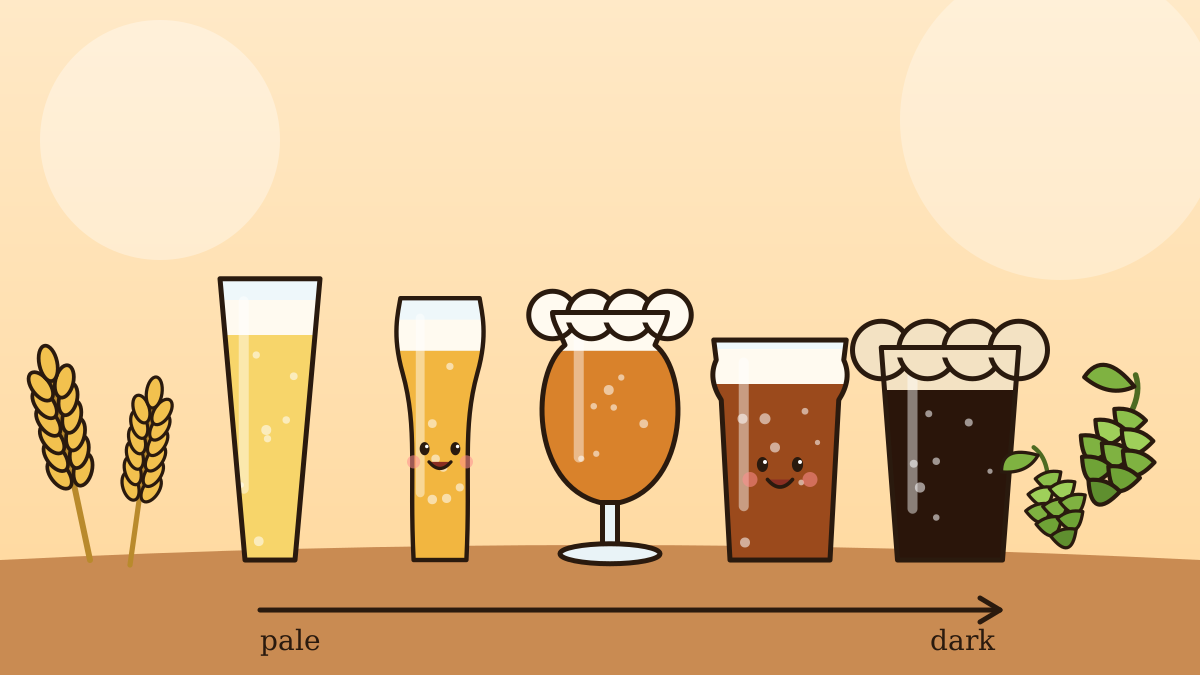
SRM (Standard Reference Method) describes colour. Low numbers are pale straw, the teens are amber and copper, and anything past about 35–40 looks black. Colour tells you about the malt, not the strength: a dry Irish stout is often lower in alcohol than a golden Belgian tripel.
Style names are a shared vocabulary, not a legal definition. Two breweries can pour very different beers under the same label, and modern brewers love to invent new categories (cold IPA, pastry stout, smoothie sour). The practical approach is to use a style name to set expectations, then let your own senses judge the beer in the glass.
If you are exploring, try tasting across one family at a time. Put a Pilsner, a Helles and a Märzen side by side and you will quickly learn what lager malt and hops do. Or line up a pale ale, a West Coast IPA and a hazy IPA to feel how hop choice and technique change things. Our tasting guide has a simple note sheet you can use.
Finally, remember that bigger is not better. Some of the hardest beers to brew well are the quiet ones: a clean, balanced lager leaves the brewer nowhere to hide. Enjoying them is a sign of a curious palate, not a timid one.
No. Lager describes the yeast and a cold, slow fermentation. Doppelbocks and Baltic porters are lagers that can be dark, rich and above 7% ABV.
A style is a broad category that many breweries brew, such as Pilsner or porter. A brand is one brewery's specific beer within (or outside) a style.
Not necessarily. Colour comes from roasted or kilned malt. Many dry stouts are around 4–4.5% ABV, while some pale Belgian tripels are closer to 8–9%.