Styles

Home › Articles › Storing Beer
Most beer is not like wine. It is at its best when it leaves the brewery and slowly declines from there. How fast it declines depends almost entirely on how it is stored. The good news is that the rules are simple, and following them makes a noticeable difference to every glass.
Think of beer freshness as a race against three forces. Light can ruin a beer in minutes. Heat speeds up every staling reaction. Oxygen, which sneaks in during packaging and through some closures, slowly dulls flavour and aroma. Time is the fourth factor that multiplies all three.
When certain wavelengths of light, especially blue and ultraviolet, hit beer, they trigger a reaction involving riboflavin and bitter compounds from hops. The product is a sulphur compound chemically very similar to skunk spray, and humans can detect it at extraordinarily low levels. That is why a beer left in the sun can smell “skunked” within minutes.
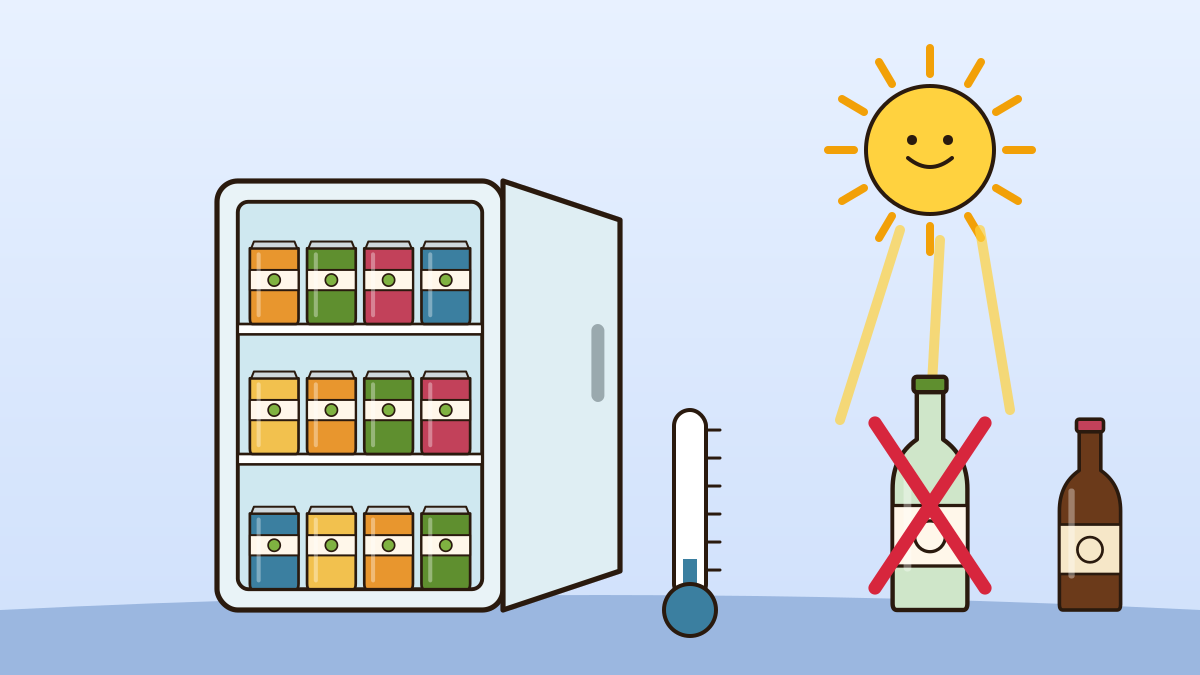
Packaging matters. Cans block light completely. Brown glass blocks much of the damaging light. Green and clear glass offer little protection, which is why beers in those bottles are more prone to skunking. Keep all beer, especially bottled beer, in the dark: inside the box, in the fridge or in a cupboard, and never on a sunny windowsill or in a bucket of ice in direct sun.
Staling reactions speed up with temperature. A beer stored warm will taste older, sooner, than the same beer kept in the fridge. For most beers, especially hoppy ones, the best place is the refrigerator, and the sooner you get it there after buying, the better.
A widely repeated myth says that letting cold beer warm up and then chilling it again “ruins” it. There is no special damage from the cycle itself. What matters is the total time the beer spends warm. A case that rode home in a warm car and then went into the fridge is fine. A case left in a hot garage for a summer is not.
Even small amounts of oxygen in a package slowly react with beer. Over weeks and months, hoppy aromas fade, malt can take on honey, toffee or sherry notes, and some beers develop a papery, “wet cardboard” flavour. Brewers work hard to minimise oxygen during packaging, but you can help by buying fresh, storing cold and drinking hoppy beers promptly.
Store most beer upright. Standing bottles keep the beer away from the cap and reduce the surface area exposed to the air inside, and in bottle-conditioned beers the yeast settles into a neat layer at the bottom that you can leave behind when you pour. Traditionally, corked bottles were laid down so the cork would not dry out, but for the typical beer you buy today, upright in a cool, dark place is the safe default.
| Drink as fresh as possible | Can often be cellared |
|---|---|
| IPAs of every kind, especially hazy | Imperial stouts, especially barrel-aged |
| Pale ales and hoppy lagers | Barleywines and old ales |
| Wheat beers and hefeweizen | Belgian quads and strong dark ales |
| Pilsners and light lagers | Gueuze, lambic and many bottle-conditioned sours |
| Fruited kettle sours | Some strong, bottle-conditioned Belgian ales |
Cellaring rule of thumb: strong (roughly 8%+), dark or wild beers, kept cool (around 50–55°F), dark and upright. Buy two and taste one now and one later.
If you cellar strong beers on purpose, keep expectations realistic. Aging changes a beer rather than simply improving it: hop bitterness and aroma fade, alcohol heat softens, and flavours of toffee, dried fruit, port or sherry develop. Some bottles become wonderful; others simply lose their spark. Buying two of the same bottle and tasting one now and one a year later is the most reliable way to learn what you enjoy, and a notebook helps you remember the difference.
Look for a “canned on,” “bottled on” or “packaged on” date, which tells you exactly how old the beer is. “Best by” dates are the brewery's estimate of when quality starts to decline, and their length varies by style. Some breweries use codes (for example a Julian date, where the day of the year is numbered 1–365); their websites usually explain how to read them. When shopping, favour stores that keep hoppy beers in a cold case and rotate stock often.
Beer filled from the tap into a growler or crowler is exposed to more oxygen than beer packaged on a canning line. Keep it cold and drink it soon: within a few days for growlers, and a little longer for a properly sealed crowler. Once opened, carbonation escapes and oxygen gets in, so finish it within about a day. For opened bottles and cans, there is no reliable way to keep leftovers fresh for long; pour smaller glasses instead.
Commercially packaged beer is very unlikely to become unsafe, but its flavour declines with time, heat and light. Old beer usually tastes dull or stale rather than harmful.
The temperature cycle itself does not ruin beer. The total time spent warm is what speeds up staling.
Often for branding and tradition. Those bottles let in more light, so keep them in their box or the fridge to avoid a skunky smell.